In 1850, Sarah Porter needed more room for the girls' school she had first opened in Farmington in 1843. She rented the Union Hotel, a brick building on Main Street that had served passengers on the Farmington Canal. Sixteen years later she bought it. The canal itself had started in 1825 and launched its first boat in 1828. By 1848 it was no longer in use, so the hotel had lost the traffic it was built for just as the school needed a home.
That sale set the pattern for most of what you see today at the corner of Main Street and Mountain Road. Miss Porter's School grew by moving into the village's existing buildings, one at a time. You can still read that history from the public sidewalk on a cold afternoon. The same walk also leads to the house that the school's best-known alumna designed up the hill.
The School Started Above a Store
Sarah Porter opened her school in 1843 above a village store. The first schoolhouse came in 1847, the hotel rental in 1850, and the purchase in 1866. Her family was already part of Farmington's fabric. Her father, Rev. Noah Porter, was the town's Congregational minister for 60 years, and her brother Noah went on to become president of Yale. After her death in 1900, management of the school passed in 1904 to her nephew, Robert Porter Keep, and his family.
That background explains why the school sits inside the village. It was founded by someone who belonged there, and it spread into buildings the village already had. The Connecticut Trust's inventory of 60 Main Street describes Main Street as "lined with historic buildings, many residential and others converted to use by Miss Porter's School and other institutions."
The Route, Stop by Stop
All of this is a working school. The buildings are meant to be seen from the street, not entered. The Trust's inventory lists the main building as closed to the public, with its exterior visible from the road.
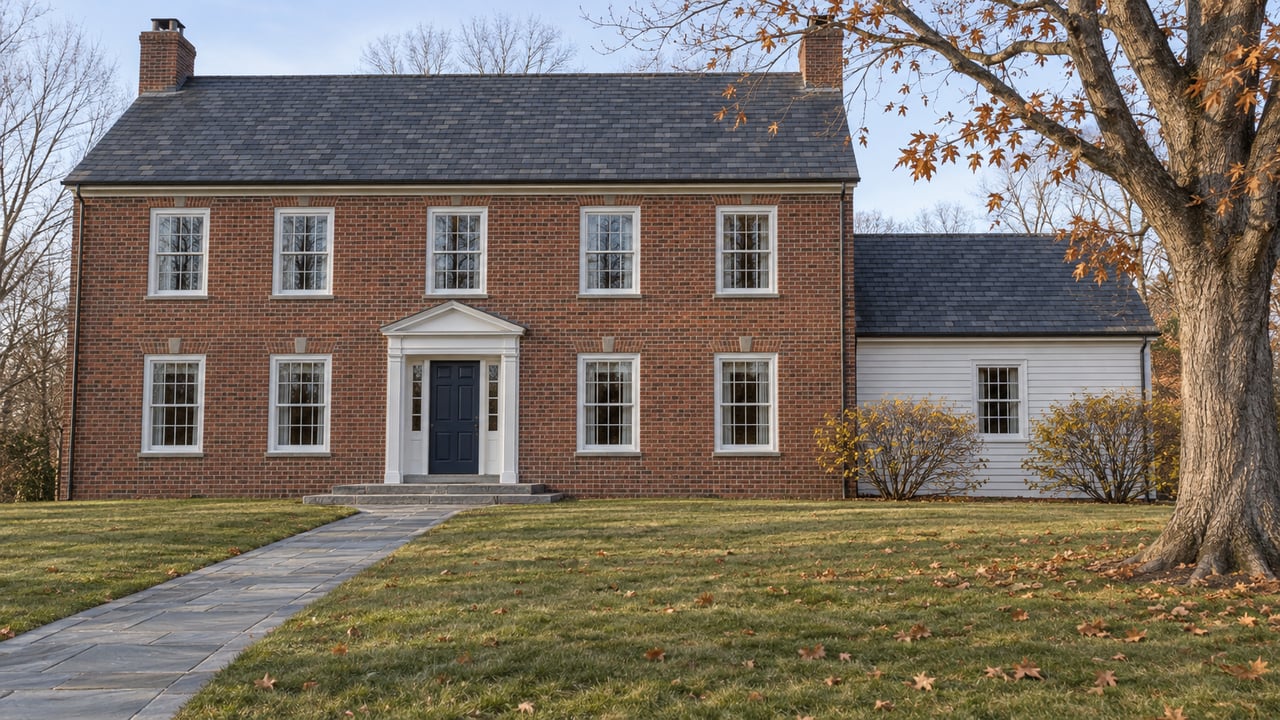
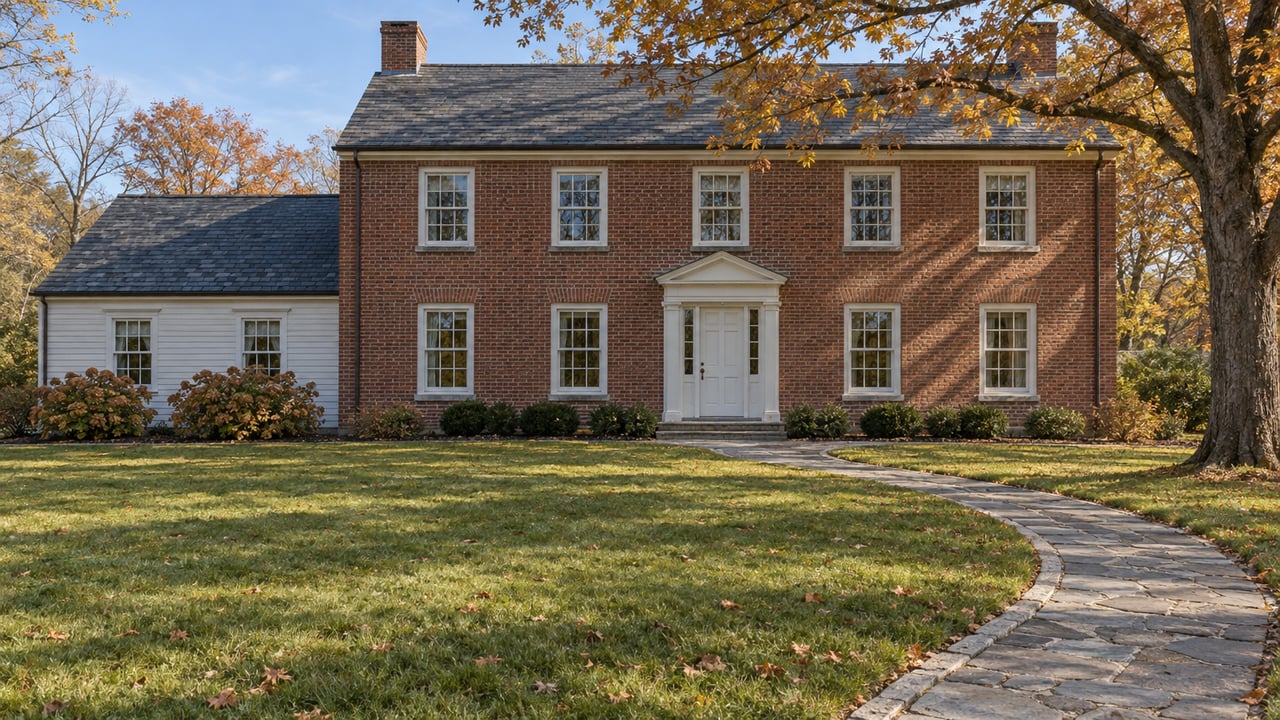
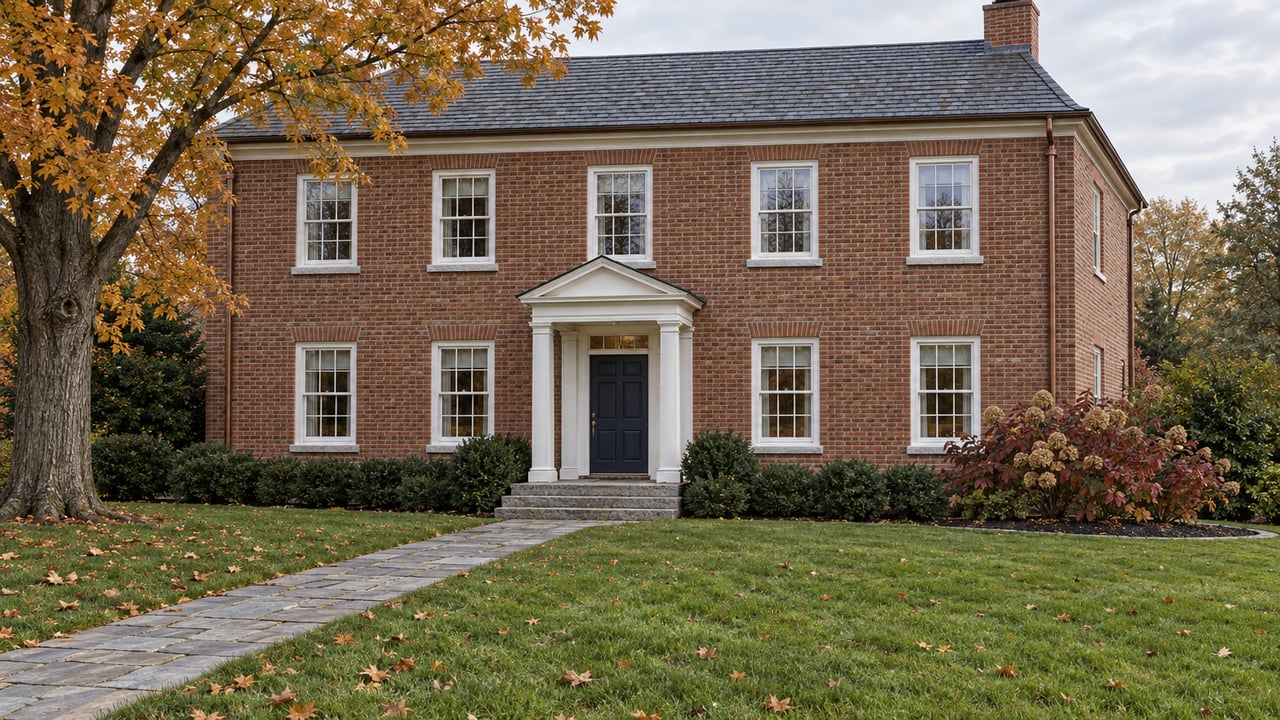
- The Union Hotel, now "Main," at 60 Main Street. It stands on the west side of Main Street at the corner of Mountain Road. It is the symbolic center and front door of the school's 12-acre campus. It is a three-story Greek Revival brick building from about 1830, with a low hipped roof and four corner chimneys. Today it serves as the school's administration building, and its side and rear additions hold dining and kitchen space.
- The Cowles Store on Main Street. Elijah and Gad Cowles built this three-story Federal-style store and warehouse between 1813 and 1818. It was a drugstore when Miss Porter's bought it in 1901. Later it held the school's Leila Dilworth Jones Memorial Library, until a new library was built in 2001.
- The Studio at 5 Mountain Road. Alumnae built this one as a memorial to Sarah Porter, with rooms for drawing, painting, and music. It was dedicated on May 29, 1885.
- Hill-Stead, up Mountain Road. This is the one stop on the route you can walk into, and the next section explains how it connects to the first three.
Stand at 60 Main Street for a moment before moving on. The 1972 Farmington Village Historic District nomination, quoted in the Trust's inventory, describes it plainly:
"The old hotel is a striking brick building standing near the road. Its porch contains a frieze and dentils, and white columns in Greek Doric style."
Look up at the cupola. It has turned balusters, with a frieze of triglyphs and metopes beneath them. Those details are easiest to see in winter, when the trees are bare. The building counts as a contributing resource in both Farmington's local historic district and its National Register district. When the village district went onto the National Register in 1972, its nomination listed the buildings housing Miss Porter's School as part of the historic center. If you own a house nearby, our earlier post on how Farmington redrew its historic district map covers how that designation works for homeowners today.
The Student Who Walked Up the Hill
Theodate Pope enrolled at Miss Porter's in 1886. She came back to Farmington in 1890 and lived on High Street in an old farmhouse she called the "O'Rourkery." The early local history Farmington: The Village of Beautiful Homes says she furnished the house to suit its period.
In 1898 her father, Alfred Pope, bought 250 acres in Farmington. He asked Theodate to work with McKim, Mead & White on plans for the house and grounds. Hill-Stead was designed and built under her direction between 1899 and 1901.
From there, her work went back to schools. She designed the campus of Westover School in Middlebury, working with its founder, Mary Robbins Hillard, whose plans for the school date to 1909. She also conceived Avon Old Farms School, laid out its campus and building design, and saw it open in 1927. Avon Old Farms still names Theodate Pope Riddle as its founder. This winter, its hockey team is defending a New England prep title at home on Old Farms Road, as we covered in our Avon Old Farms hockey preview.
So the two schools are linked. A student educated in Main Street buildings that had been converted to school use went on to design two campuses of her own. The walk from 60 Main Street up Mountain Road to Hill-Stead follows that same path.
What Is Open at the Top of the Walk
The Hill-Stead Museum grounds and hiking trails are free and open daily from 8 a.m. to 5 p.m., except on major holidays, and the security gate closes at 5. Winter sunsets come early, so plan to arrive in daylight.
The house is open Wednesday through Sunday, 10 a.m. to 4 p.m., by guided tour only. The first tour starts at 10 a.m. and the last at 3 p.m. Tours take up to 12 people and are first-come, first-served.
Back in the village, Stanley-Whitman House runs a December schedule that pairs well with the walk. Here are the dates on the calendar after this post goes live:
| Date | Venue | Event | Details |
|---|---|---|---|
| Sat., Dec. 5, and Sun., Dec. 6 | Hill-Stead Museum | Holiday Boutique | 10 a.m. to 4 p.m. both days. Admission is free, pre-registration is requested, and paid guided house tours are available |
| Sun., Dec. 6 | Stanley-Whitman House | Cantica Nativitatis | 2 to 3 p.m., music about Christmas traditions |
| Tue., Dec. 8 | Hill-Stead Museum | The Art of Looking: Wallace Stevens and Karen Bondarchuk | 6 to 8 p.m., with poetry, music, an exhibition viewing, and a reception |
| Sat., Dec. 12 | Stanley-Whitman House | 20th Annual Candlelight Tours | Tours every half hour from noon through 3 p.m., covering Farmington's Christmas and winter customs |
| Sun., Dec. 20 | Stanley-Whitman House | Winter Solstice & Christmas in Ireland | 2 p.m. |
Stanley-Whitman House notes that its schedule can change, so check its page before you go.
December 5 makes the fullest version of the walk. Start at the corner of Main Street and Mountain Road in the late morning, pass the Cowles Store and the 1885 Studio, and reach Hill-Stead in time for the boutique and a guided house tour before the 3 p.m. cutoff. On December 12, you can do the walk with an afternoon candlelight tour at Stanley-Whitman House added on.
For more on the village and the rest of town, see our Farmington neighborhood page.
Many of the houses in Farmington village have long histories of reuse, much like the Union Hotel. If you are thinking about buying or selling one, or simply want to know what your own building's past might mean for its future, the team at Jacek Mikolajczyk knows these streets and would be glad to talk it through. Let's Connect.